

Your AC cuts out on a humid July afternoon, and suddenly you’re reviewing an estimate, wondering if the price is fair. It’s a moment where you have to balance your home’s comfort with your budget, and make a quick decision with limited information.
Most HVAC repair bills are built from the same core elements: a diagnostic fee, labor, replacement parts, and sometimes refrigerant. Understanding how these pieces fit together helps you avoid sticker shock when the invoice arrives. This guide breaks down typical price ranges for Montgomery County homeowners, the key factors that affect your total, and how to evaluate repair versus replacement decisions before costs escalate.
As a family-owned team serving Montgomery County and the Philadelphia suburbs, we focus on transparent pricing. While every situation is different, the cost structure behind HVAC repairs is consistent. Here’s what typical repair costs look like on a real invoice.
How Much Does HVAC Repair Cost? Tiered Pricing and Fees
A typical HVAC repair cost falls into three tiers: minor fixes range from $150 to $400, mid-level repairs from $400 to $1,200, and major component failures can exceed $2,000. Final costs depend on labor time, system type, and the specific parts required.
Most repair visits include two initial charges: a trip fee for travel and a diagnostic fee to identify the issue. In many cases, this diagnostic fee is credited toward the total if you move forward with the repair.
Common repair benchmarks:
- Electrical ($150 to $400): Capacitors or contactors.
- Mechanical ($400 to $1,200): Blower motors or inducer fans.
- Control ($300 to $1,000): Circuit boards.
Standard parts are often stocked on service trucks for same-day repairs, while specialized components may need to be ordered, adding time to the job.
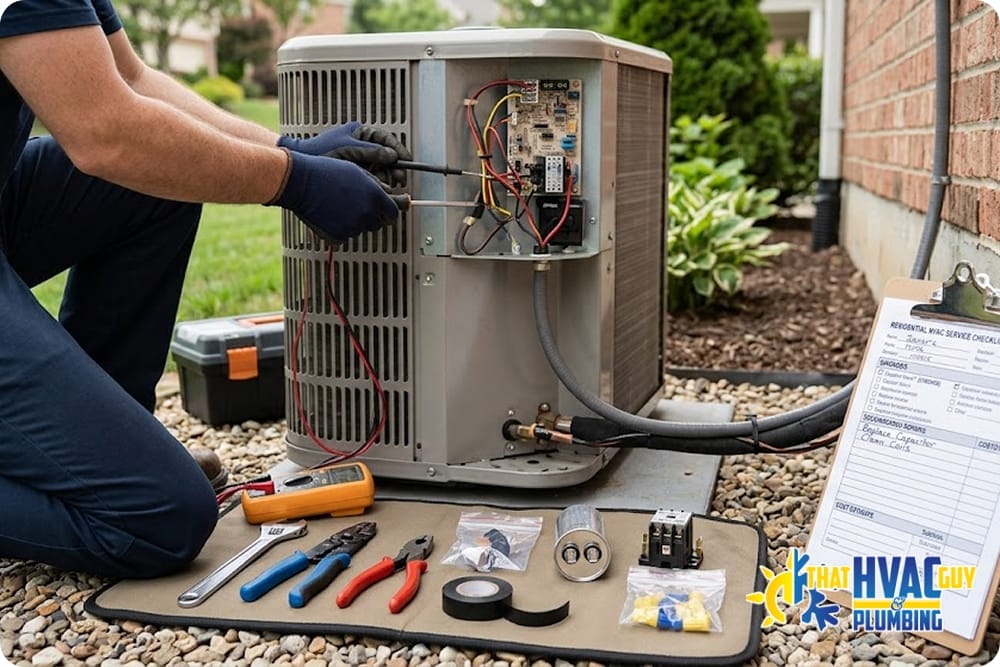
Beyond the Part: Why One HVAC Repair Cost Differs From the Next
A common misconception is that you’re only paying for a replacement part. In reality, HVAC repair costs reflect diagnostic expertise, labor, system complexity, and compliance requirements. For example, repairing an older single-stage unit is usually less expensive than fixing a high-efficiency inverter system with proprietary components.
Factors that drive your final quote:
- Proprietary Controls: Inverter systems and variable-speed boards are specialized and expensive.
- Labor Rates: Technician shortages have increased market rates for skilled trade work.
- Scheduling: Emergency, after-hours, or weekend calls often carry a premium.
- Access Difficulty: Tight crawlspaces or roof units require more time and safety measures.
- System Type: Heating systems like boilers require different diagnostics than furnaces or mini-splits.
- Warranty Status: Even when a part is covered under warranty, the installation labor is not.
- Refrigerant Work: Any air conditioning repair involving refrigerant includes recovery, leak detection, and recharge. Prices for these fluids fluctuate due to the ongoing industry transition to newer regulated refrigerants.

Repair or Replace? A Decision Framework for Homeowners
Evaluating an HVAC repair cost goes beyond the immediate price. This framework helps you decide whether repairing your system makes financial sense:
System Age
Units under 10 years are usually worth fixing. If your system is between 12 and 15 years old, you are approaching end-of-life territory.
The 50% Rule
If a repair quote costs half the price of a new system, replacement is almost always the smarter long-term investment.
Efficiency
Modern high-SEER systems can reduce monthly cooling bills by 15 to 20 percent, helping the upgrade pay for itself over time.
Safety and Warranty
Ask our team to verify your manufacturer warranty before paying for parts. If you detect gas smells or see smoke, call for emergency service right away.
Urgent Red Flags
- No heat or cooling during extreme temperature spikes.
- Burning electrical odors or repeated breaker trips.
- Water pooling around the unit or visible ice on refrigerant lines.
These issues typically require same-day service rather than a wait-and-see approach. If you notice any of these signs, contact a professional immediately.
How to Get an HVAC Repair Estimate Before You Approve It
A repair bill should not feel like a guessing game. Once you receive an estimate, use this checklist to confirm the pricing is fair and the scope of work is clearly defined.
Ask about the diagnostic fee
Confirm whether this charge applies toward the total repair cost if you move forward.
Request a plain-English explanation
You should understand exactly which component failed and how it caused your specific symptoms.
Verify the parts
Ask whether the technician is using Original Equipment Manufacturer (OEM) or universal parts, and what warranty covers each.
Demand a price breakdown
A professional quote separates labor, parts, and refrigerant costs on separate line items.
Clarify the follow-up policy
Ask what happens if the initial repair does not solve the underlying problem.
If you want a written estimate with clear options and no surprises, schedule a visit and get it in writing.
Frequently Asked Questions About HVAC Repair Cost
How much should I budget for an HVAC repair?
Most homeowners spend between $150 and $450 for common HVAC repairs, while major issues can exceed $1,500 depending on parts and labor.
What is an HVAC diagnostic fee, and is it separate from the repair?
An HVAC diagnostic fee covers the technician’s time, travel, and tools needed to identify the issue. It is usually separate but may be credited toward the repair.
Why is refrigerant so expensive right now?
Refrigerant costs include handling, certification, equipment, and regulatory changes, which is why prices have increased in recent years.
How do I read an HVAC repair estimate line by line?
A clear estimate should list parts, labor, refrigerant, and fees separately. Avoid vague quotes without itemization.
When is an HVAC repair no longer worth the investment?
Repair may not be worth it if your system is over 12 years old and the cost exceeds 50% of a replacement.
Understanding HVAC repair cost before a technician arrives helps you make informed decisions. Factors like system age, repair type, and the 50% rule matter more than the initial quote alone. If you want a clear, honest breakdown of your options, our team is here to help.