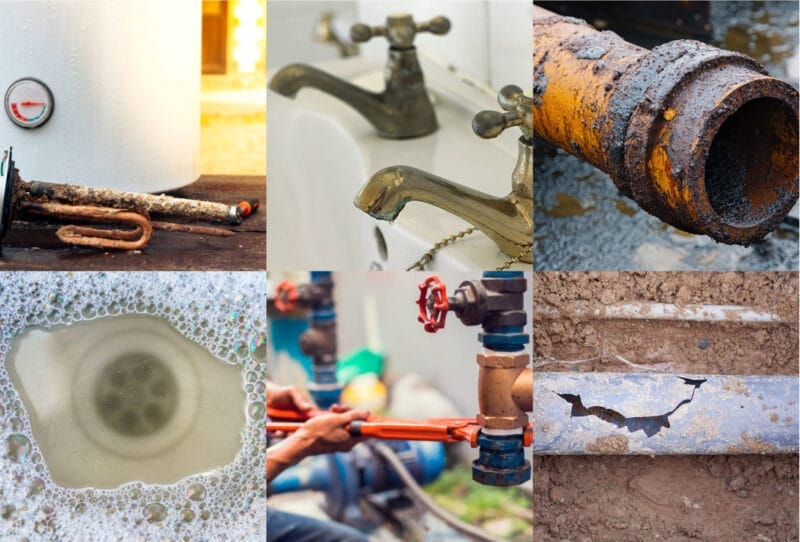

Hard water leaves calcium and magnesium deposits that can appear as cloudy glassware, soap scum, scale on faucets, stiff laundry, and reduced water flow. If you notice several of these signs and your water tests around 7 grains per gallon (120 mg/L) or higher, it may be time to consider a water softener or another hard water treatment option.
You may first notice hard water when glasses come out of the dishwasher cloudy or a chalky film keeps returning to your shower doors and faucets. These are common signs of mineral buildup, but visible symptoms alone cannot tell you how hard your water is or which treatment will work best. Testing your water gives you the information you need to decide whether a softener, conditioner, or another solution makes sense for your home.
This guide explains how to recognize the most common signs of hard water, check your local water quality data, and confirm your home’s actual hardness level. You will also learn the differences between water softeners, salt-free conditioners, and targeted filtration so you can choose a solution based on your water conditions and household needs.
7 Signs Your Home May Need a Water Softener
Hard water can affect more than the appearance of your fixtures. Over time, calcium and magnesium scale can build up in plumbing and water-using equipment, restrict water flow, reduce water-heater efficiency, and increase the amount of soap or detergent your household needs. Watch for these seven common signs:
Cloudy or spotted glassware
Glasses and dishes come out of the dishwasher with a chalky film or mineral spots.
Soap scum and poor lather
Residue builds up quickly on tubs and shower doors, while soap and shampoo require more product to create a good lather.
Dry-feeling skin or dull hair
Hard water can make soap harder to rinse clean, leaving residue that may make skin feel dry and hair look dull or harder to manage.
White scale on fixtures
Chalky or crusty mineral deposits repeatedly form around faucets, showerheads, and other water fixtures.
Stiff or dull laundry
Clothes may feel rough after washing, and you may need more detergent than usual to get them clean.
Gradually decreasing water pressure
Over time, hard water can affect your plumbing as scale accumulates inside pipes and restricts water flow. If pressure has slowly declined throughout the home, mineral buildup may be one contributing factor.
Declining water-heater performance
Scale can collect on heating surfaces and reduce efficiency, which may contribute to slower hot-water recovery or increased energy use.
One symptom alone does not confirm that you need a water softener. Cloudy glasses, low water pressure, or changes in water-heater performance can have other causes, so look for a pattern of hard-water signs and confirm your hardness level before choosing a treatment system.

How to Check Your Water Hardness in Pennsylvania
The best way to know how hard your water is depends on your water source. If your home uses municipal water, start with your water provider’s published water-quality information. If you use a private well, an actual water test is the more reliable way to determine your home’s hardness level.
For municipal water, search your water provider’s name plus “Consumer Confidence Report” or “water quality report.” Some utilities publish total hardness in the report or elsewhere on their website. If hardness is not listed, contact the provider and ask whether they can provide a recent hardness range for your supply.
Treat that number as a useful baseline; an on-site test will give you a more specific reading for your home.
Water hardness may be reported in milligrams per liter (mg/L), parts per million (ppm), or grains per gallon (gpg). To convert mg/L or ppm to gpg, divide the number by approximately 17.1:
gpg = mg/L ÷ 17.1
| Hardness Level | Grains per Gallon (gpg) | mg/L or ppm |
|---|---|---|
| Soft | Less than 1.0 | Less than 17 |
| Slightly hard | 1.0–3.5 | 17–60 |
| Moderately hard | 3.5–7.0 | 60–120 |
| Hard | 7.0–10.5 | 120–180 |
| Very hard | More than 10.5 | More than 180 |
If your provider does not publish hardness data, a home hardness test strip can give you a useful preliminary reading. Water at about 7 gpg (120 mg/L) or higher falls into the hard range and is more likely to produce noticeable scale and soap-related problems.
If that result matches the symptoms you are seeing at home, professional testing can help confirm the reading and determine which type of treatment is appropriate. For homes with private wells, testing is especially important because a municipal water report does not represent your individual well.
Water Softener vs. Conditioner vs. Filter: What’s the Difference?
Not every water treatment system removes hardness from your water. Softeners, conditioners, and filtration systems solve different water-quality problems, so the right choice depends on what your water test shows and what you want the system to accomplish.
| Treatment | What It Does | Removes Hardness? | Best Fit |
|---|---|---|---|
| Ion-exchange water softener | Reduces calcium and magnesium through ion exchange | Yes | Homes with confirmed hard water where the goal is softer water and reduced scale |
| Salt-free conditioner | Changes how hardness minerals behave to help reduce scale formation | No | Homes focused on scale control without salt or regeneration wastewater |
| Whole-house filtration | Targets specific water-quality concerns such as chlorine, sediment, tastes, or odors depending on the filter | Usually no | Homes with water-quality concerns beyond hardness |
That HVAC Guy provides professional water filtration and softening solutions for homeowners in Montgomery County and surrounding communities. Jordan and the team can evaluate your water source, hardness level, household demand, and specific water-quality concerns before recommending a system.

How to Choose the Right Hard Water Treatment for Your Home
Choosing a treatment system starts with your measured hardness level, but the number alone does not determine the right solution. Consider the problems you want to solve, your water source and household demand, and whether you want true mineral removal, scale control, or treatment for a different water-quality concern.
- Confirmed hard water with recurring scale and soap-related problems: If your water tests around 7 gpg or higher and you regularly see scale, cloudy glassware, poor soap lather, or hard-water buildup, an ion-exchange softener may be a good fit. It directly reduces the calcium and magnesium responsible for hardness. Reducing hardness can also help limit scale that affects plumbing and water heater performance.
- Hard water with scale control as your main goal: If you want to reduce scale formation but do not want salt-based regeneration, a salt-free conditioner may be worth considering. Keep in mind that it does not remove hardness minerals, so the water will not become truly soft.
- Few hard-water signs or different water-quality concerns: Do not assume you need a whole-home softener. If your primary concern is taste, odor, sediment, staining, or another isolated water-quality issue, testing can help determine whether filtration or another treatment is more appropriate.
Once you understand the problem you are trying to solve, use these four steps to narrow down the right system:
- Confirm your water conditions. Start with a hardness test or available utility data rather than relying on visible symptoms alone. If you use a private well or have staining, sediment, unusual tastes, or odors, additional testing may be appropriate.
- Define your treatment goal. Decide whether you want to reduce hardness minerals, control scale without true softening, or address a separate issue such as chlorine, sediment, taste, or odor.
- Account for household demand. System capacity and flow requirements should reflect household size, water use, hardness level, and the fixtures the system will serve.
- Compare system and maintenance requirements. An ion-exchange softener provides true hardness reduction but requires regeneration and salt or potassium replenishment. Salt-free conditioners focus on scale control and have different service or media requirements depending on the system.
Before choosing equipment, ask about ongoing maintenance, regeneration frequency, salt or media replacement, expected service intervals, and manufacturer requirements. A system that fits your water chemistry should also be practical for your household to maintain over time.
Jordan and the team at That HVAC Guy can test your water and recommend a system based on your hardness level, water source, household demand, and treatment goals. They provide water treatment solutions for homeowners throughout Montgomery and Bucks County.
Request a Water Quality Estimate
Frequently Asked Questions About Hard Water in Pennsylvania
Will a water softener damage my septic tank?
A properly sized and efficiently operated water softener can generally be used with a septic system. Research summarized by the Water Quality Association indicates that efficient household softeners do not negatively affect septic performance under proper operating conditions.
If softener regeneration water discharges into your septic system, make sure the equipment is correctly programmed and installed in accordance with local plumbing and wastewater requirements.
Is a salt-free water conditioner just as good as a salt-based softener?
Not if your goal is true water softening. Salt-free conditioners are designed primarily to reduce scale formation, but they do not remove the calcium and magnesium that cause hardness. Because those minerals remain in the water, a conditioner will not produce the same result as an ion-exchange softener.
If your priority is actual hardness reduction, an ion-exchange system is the more appropriate option; if your priority is scale control without salt-based regeneration, a conditioner may make more sense.
Why Does Pennsylvania Have Hard Water in Some Areas?
Water hardness varies across Pennsylvania because it depends heavily on local geology and the source of the water. Groundwater that moves through limestone and dolomite can dissolve higher amounts of calcium and magnesium, producing hard or very hard water.
Other aquifers in the state can produce softer water, so hardness can differ considerably from one water system or well to another. Public water can also be hard when the source naturally contains high levels of hardness minerals, which is why testing your specific supply is more useful than relying on a statewide assumption.
How often do I need to add salt to my water softener?
There is no universal salt-refill schedule because usage depends on your water hardness, household water consumption, softener capacity, and regeneration settings. Check the brine tank about once a month and refill it according to the equipment manufacturer’s recommendations rather than waiting for the salt to run out. If your system suddenly starts using much more or much less salt than usual, it may be worth having the settings and regeneration cycle checked.
When should I hire a professional to test my water instead of using a DIY kit?
A DIY hardness strip is useful when you only need a quick estimate of calcium and magnesium hardness. Consider a professional water-treatment evaluation when you have persistent scale, staining, sediment, unusual tastes or odors, or when you need to size and configure a treatment system.
If you use a private well or are concerned about drinking-water safety or specific contaminants, a certified laboratory test may also be appropriate. That HVAC Guy can perform on-site testing for hardness and other water-quality concerns to help determine which treatment system fits your home’s conditions.